I am a digital nomad and entrepreneur specializing in the curation of online information focused on the fields of business and travel. I run numerous websites, including MBA Depot, MBA Boost, Management Ideas, Dado Que and Lengthy Travel. I received my MBA from the University of Texas at Austin.

Use Humor

Use your sense of humor to add a positive experience to the sales call. People love to laugh and feel good. If you don’t have a sense of humor, your prospect is not someone to practice on. Sarcasm, joke telling and self-deprecating humor leaves you on thin ice. I’ve seen sales people crash and burn with an underdeveloped sense of humor. If you use … [ Read more ]

Pay Employees to Quit

During the first month of training, Zappos offers new employees $2,000 to quit, plus their time worked. It sounds expensive, but in the long term, it’s not. We want people to be here because they are passionate about customer service and because they like our culture. We don’t want people who are just here for a paycheck. Those people generally end up leaving six or … [ Read more ]

Annual Report for Technology

A company’s business units and technology organization need to be much more in tune with each other. Here’s a simple idea: have the CEO and CTO jointly issue an annual report for technology—something analogous to the annual report for investors and the broader market. This document would not only provide a candid overview of the ability to extract business value from technology but also substantiate … [ Read more ]

An Alternative to Price Cuts When Customers Are Fearful

In a downturn, some consumers and businesses cut back because they just don’t have the money to spend. Many more prospective customers have the money but feel uncertain about the future. Spooked consumers won’t buy more until they feel that it is safe to do so, or until they decide that prices have dropped as far as they’re going to. A company needs to understand … [ Read more ]

Fiercest Competitor Workshop

One good way to get at these disruptive designs (innovations) is to do what we at my firm call a “Fiercest Competitor Workshop,” which starts with the premise that you have been fired from your old organization but you have access to ample capital and talent. Your task is to design the fiercest competitor that could take the market from your old firm. In my … [ Read more ]

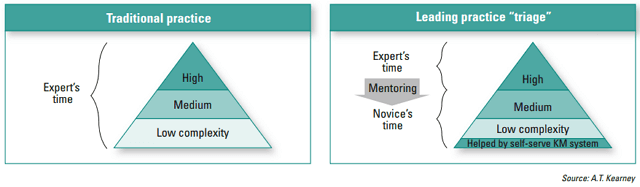
“Triage” Project Work to Maximize Expert’s Time

A leading company in the area of project management employs a “triage” system to maximize the effectiveness of its key engineers. Moderately-skilled workers assess the work to quickly identify work that less-skilled workers or novices can perform and free up experts to handle the more challenging, complex work (see fgure).

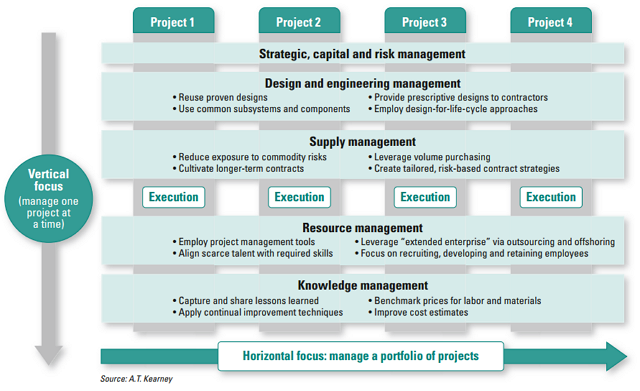
A Horizontal Process for Managing Projects

A “horizontal” focus is evolving as leading companies stress the importance of cross-project capabilities. For example, one leading company established a central program management group to oversee functional areas across the organization—including procurement and finance—and deliver projects across business units. Projects are put through a cross-functional approval process to ensure they meet all designated criteria and leverage existing knowledge and scale. The group also monitors … [ Read more ]

Strategic Role Assessment (SRA)

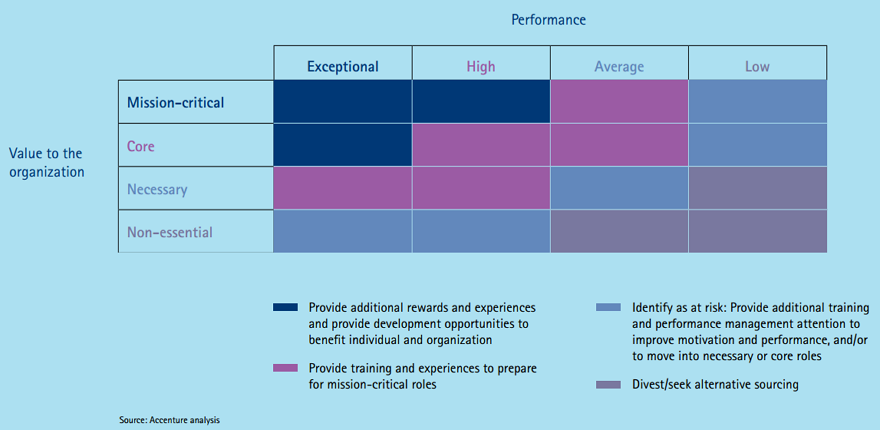
Companies need a more comprehensive approach to reducing workforce costs without impairing workforce quality. To do this effectively, a company needs a better understanding of the different roles within its workforce and needs to conduct what we call strategic role assessment, or SRA.

The purpose of SRA is to identify strategic talent—individuals who are top performers relative to their peers and who perform … [ Read more ]

Identifying Employee Skill Gaps

Identifying the areas where organizations need to improve their capabilities most is an important step in any change effort. Such a skill is helpful particularly in times of cost-cutting–where limited training resources must be used to close the critical competency gaps that prevent companies from meeting business objectives.

However, many training programs don’t yield the desired results. One reason is that they are usually launched … [ Read more ]

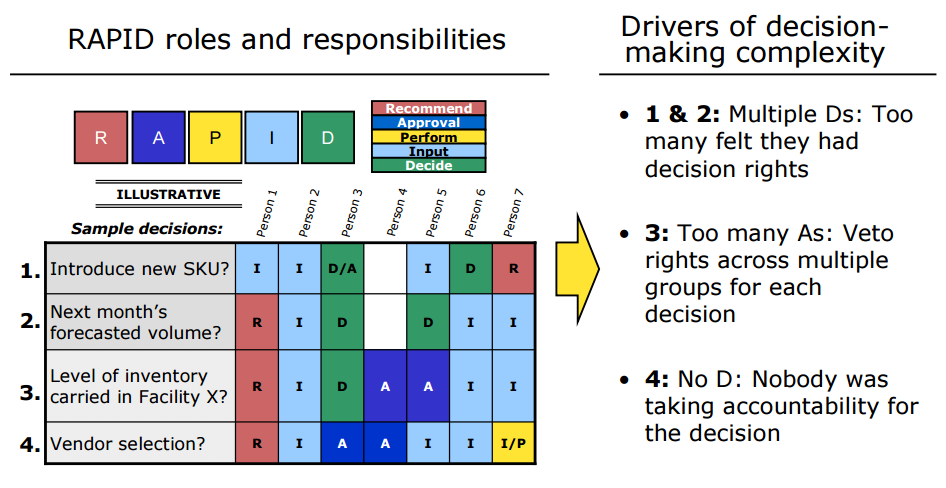
RAPID

A useful tool to zero in on decision-making problems and create higher-yielding change programs is a decision management tool we call RAPID. The idea is to clearly map out who plays what role in each critical decision and use that to enable swift decisions, without endless debates, second-guessing or pocket vetoes. It determines the captain of the boat, so to speak, but in a more … [ Read more ]

Issue Mapping

Issue mapping involves identifying all the stakeholders and decision influencers involved with ordering, stocking, displaying, promoting, buying, using, servicing and disposing of a product or a service. It helps to paint a fully dimensional picture of its impact and interaction with consumers and the marketplace. It is also quite useful in combination with work-flow mapping, the visual mapping of the steps an individual takes to … [ Read more ]

Downsizing Effectively: Eliminate Hierarchy

The way a company approaches downsizing can make or break its performance. Using 355 undergraduates as their sample, the authors randomly assigned five-person teams to work on military-based command-and-control simulations. The teams’ performance was gauged first at full strength in control groups and then after one of three separate downsizing approaches was applied to the same groups.

The first approach was to maintain the hierarchy, eliminating … [ Read more ]

How to Manage Better in Just 20 Minutes

Ask an employee to write down the names of four people who have had a huge positive impact on his life — peoples he respects, admires, or looks up to. The people can be famous or mundane, real or fictional, dead or alive.

Next, ask your employee about each name, one at a time. Who is this person? Why is he or she important to you? … [ Read more ]

Tracking Employee Skills with a “Passport”

Have employees start their careers by completing a “passport” profile that accompanies them as they move between projects and assignments. As each project is finished, a manager signs off on what the employee accomplished and what skills were updated or acquired. Job responsibilities are defined and competencies clearly indicated for each role, making it much easier to determine specific training and education needs. Succession planning … [ Read more ]

Track What Employees Actually Do

We did a simple thing that in retrospect was brilliant: We wrote a program that asks every engineer what they did every week. It sends them e-mail on Monday, and concatenates the e-mails together in a document that everyone can read. And it then sends that out to everyone and shames those who did not answer by putting them on the top of the list. … [ Read more ]

How to Manage People in 15 Minutes a Day

It’s how you lead, not how much, that counts. Want to have maximum impact in minimum time? Use what I call the 3.1% Coach method. Limit your people-development activities to no more than 15 incremental minutes per day (that’s 75 minutes a week, or 3.1% of a hypothetical 40-hour workweek). Then employ the “smart coach approach” to leverage that tiny slice of time for results.
[ Read more ]

Deploy a Redeployment Pool

Intel monitors changing skill requirements and institutes a redeployment program when it becomes necessary to downsize a business. Under this program, managers effectively lay off people, and the head count of the business unit is moved off the payroll. These excised people enter a redeployment pool under the auspices of human resources. Once in the pool, employees generally have four to six months, and can … [ Read more ]

Establish a Regular Review Process

Establish a regular review process for yourself, your team, and your organization to reflect on the reasons for both your failures and successes. This is a fundamental and critical component of learning. Based on the input of everyone involved, some organizations produce substantial documents or booklets on “lessons learned” following a major new product, service, or business launch.

The Entire Business Should Be the “Customer Service Department”

Obviously, a customer service department is needed, but the traditional customer service mentality needs to be replaced by a tribal mentality.

Employees from all levels of the business should actively be making connections with customers. Not just when a customer is having trouble, but through every phase of business. Here’s a great idea: Each day, allow one randomly selected customer service phone call or email to … [ Read more ]

Use Downsizing as a Last Resort: Some Alternatives

  • Rely on attrition to right size.
  • Use redeployment and make layoffs a last resort. Hewlett Packard used this strategy extensively throughout the 1980s as it faced intensified competition. Employees were given three months to find a job in HP and were helped to do so. If they could not find an equivalent level job, they were offered a lower level job. If they preferred

[ Read more ]