Fostering Communication Across Silos

Require each senior manager in the company to share an office with a peer from another department. Have the rest of the staff sit in open spaces. These arrangements “make it easy for people to take five minutes between phone calls to talk. They also send a message about how important we believe teamwork is.”

Institutionalizing a Feedback Process: The Feedback and Change Team (FACT)

Mosaic, a faith-based nonprofit organization that provides a variety of support services for people with developmental disabilities, has institutionalized a feedback process. Mosaic has more than 4,800 employees in 50 communities in 15 U.S. states and Great Britain. Very few of them directly report to a central administration office, which could hinder communication. So Mosaic developed the Feedback and Change Team (FACT), which consists of … [ Read more ]

Make Your Employees’ Dreams Come True

One easy, fun and impactful system you can put in place is called the “101 Dream Goals.” Give each employee thirty minutes and have them write as many things they can think of that:

* They’d like to buy
* They’d like to do
* They want to learn
* They want to try for the first time
* Personal goals they want to … [ Read more ]

Create an Independent “Market Sensing” Function

Improving information flow is not just a matter of rolling out a new IT system; it’s a more complex endeavor. It’s not just how data gets to headquarters that is material, but what data gets there and how it is framed. Often, competitive realities have been white-washed by the time they are revealed to the executive suite.

Some winning companies create an independent “market sensing” function … [ Read more ]

Let the Employees do the Rewarding

In a hierarchy, the lion’s share of recognition and recompense goes to those who hold the biggest titles. The real heroes are left unsung.

Linden Lab’s Remedy: The community—not some select group of corporate overlords—does the rewarding. …It does this through a software tool, called the Rewarder.

Each quarter, every associate is given an equal share of a portion of Linden’s net proft—recently, about one thousand … [ Read more ]

The Premortem Technique

The premortem technique is a sneaky way to get people to do contrarian, devil’s advocate thinking without encountering resistance. If a project goes poorly, there will be a lessons-learned session that looks at what went wrong and why the project failed—like a medical postmortem. Why don’t we do that up front? Before a project starts, we should say, “We’re looking in a crystal ball, and … [ Read more ]

The Love Machine

Philip Rosedale, Linden Lab’s charismatic founder and chairman, took one long night to build a simple but potent tool for community building. He calls it the “Love Machine.” It’s a Web page that lets any of Linden’s roughly three hundred associates zap a quick-hit message of appreciation to a colleague.

Say a coder beats a do-or-die deadline for patching a troublesome bug that’s infected Second Life’s … [ Read more ]

Improving Personal Contact with Top Staff

The CEO of a luxury goods company identified personal contact with his top staff as an important lever that would help move the business if he invested his discretionary time in it. “I always carry two documents with me,” he said. The first is a set of pictures of his direct reports and “every day I mentally ask myself, ‘Have I talked to these guys’? … [ Read more ]

Improving the Company by Doing Less

Instead of asking employees to suggest new initiatives to improve the company, why not turn the question around? Ask employees for ideas about what to terminate. Employees often respond with a slew of good suggestions. …Regularly ask yourself, your managers, and the whole company: “Which of our current activities would we start now if they weren’t already under way?” Then eliminate all the others.

Doughnuts and BlackBerrys

Research in Motion (RIM), maker of the ubiquitous BlackBerry, is one company that takes great pains to signal its distance from the shareholder value principle. Back in 1997, just after the firm’s IPO, the founders made a rule that any manager who talked about the share price at work had to buy a doughnut for every person in the company. Early infractions were not terribly … [ Read more ]

Surfacing Critical Issues

Most companies are accustomed to identifying major internal issues, such as whether to build a business, divest an asset, or lay off people. What’s harder is the early surfacing of opportunities and threats arising out of external events such as dramatic shifts in demand, competitive behavior, industry structure, regulation, or the macroeconomic environment.

A commonsense approach to identifying such issues early is to poll, regularly, all … [ Read more ]

Replace Annual Performance Reviews with Monthly Ones

Henry Chidgey, who once ran several railroad and diamond companies, advocates monthly performance reviews. These reviews need not and should not be complex; they work best when kept extremely simple. Maximum accountability is the main goal.

Here’s how the process works. The day before meeting, your coworker brings you a list of five or six key objectives, detailing her progress on each. During the … [ Read more ]

Problems Don’t Age Well

Many of us subscribe to the “cockroach theory,” the idea that earnings shortfalls and other problems are like cockroaches: there’s never just one. As a result, stocks commonly sell off more than an earnings miss seemingly warrants. The cockroach theory works because business executives rarely take the vigorous steps necessary to ensure that bad news reaches them. All too often, problems get stuck in the … [ Read more ]

Use Humor

Use your sense of humor to add a positive experience to the sales call. People love to laugh and feel good. If you don’t have a sense of humor, your prospect is not someone to practice on. Sarcasm, joke telling and self-deprecating humor leaves you on thin ice. I’ve seen sales people crash and burn with an underdeveloped sense of humor. If you use … [ Read more ]

Pay Employees to Quit

During the first month of training, Zappos offers new employees $2,000 to quit, plus their time worked. It sounds expensive, but in the long term, it’s not. We want people to be here because they are passionate about customer service and because they like our culture. We don’t want people who are just here for a paycheck. Those people generally end up leaving six or … [ Read more ]

Annual Report for Technology

A company’s business units and technology organization need to be much more in tune with each other. Here’s a simple idea: have the CEO and CTO jointly issue an annual report for technology—something analogous to the annual report for investors and the broader market. This document would not only provide a candid overview of the ability to extract business value from technology but also substantiate … [ Read more ]

An Alternative to Price Cuts When Customers Are Fearful

In a downturn, some consumers and businesses cut back because they just don’t have the money to spend. Many more prospective customers have the money but feel uncertain about the future. Spooked consumers won’t buy more until they feel that it is safe to do so, or until they decide that prices have dropped as far as they’re going to. A company needs to understand … [ Read more ]

Fiercest Competitor Workshop

One good way to get at these disruptive designs (innovations) is to do what we at my firm call a “Fiercest Competitor Workshop,” which starts with the premise that you have been fired from your old organization but you have access to ample capital and talent. Your task is to design the fiercest competitor that could take the market from your old firm. In my … [ Read more ]

“Triage” Project Work to Maximize Expert’s Time

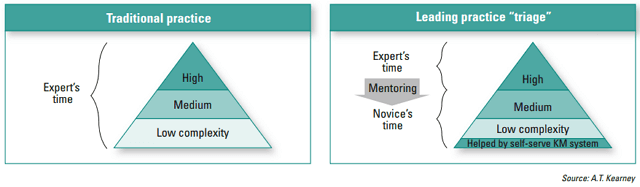
A leading company in the area of project management employs a “triage” system to maximize the effectiveness of its key engineers. Moderately-skilled workers assess the work to quickly identify work that less-skilled workers or novices can perform and free up experts to handle the more challenging, complex work (see fgure).

A Horizontal Process for Managing Projects

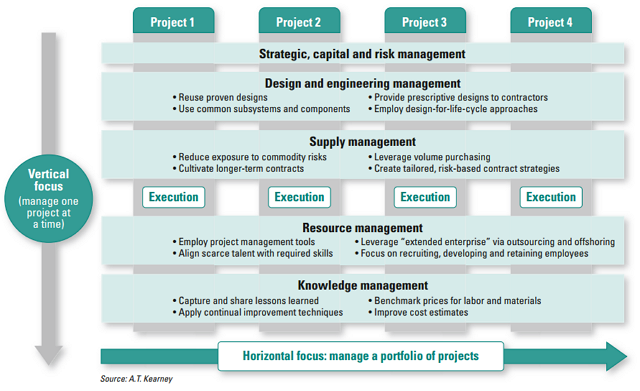
A “horizontal” focus is evolving as leading companies stress the importance of cross-project capabilities. For example, one leading company established a central program management group to oversee functional areas across the organization—including procurement and finance—and deliver projects across business units. Projects are put through a cross-functional approval process to ensure they meet all designated criteria and leverage existing knowledge and scale. The group also monitors … [ Read more ]