Strategic Role Assessment (SRA)

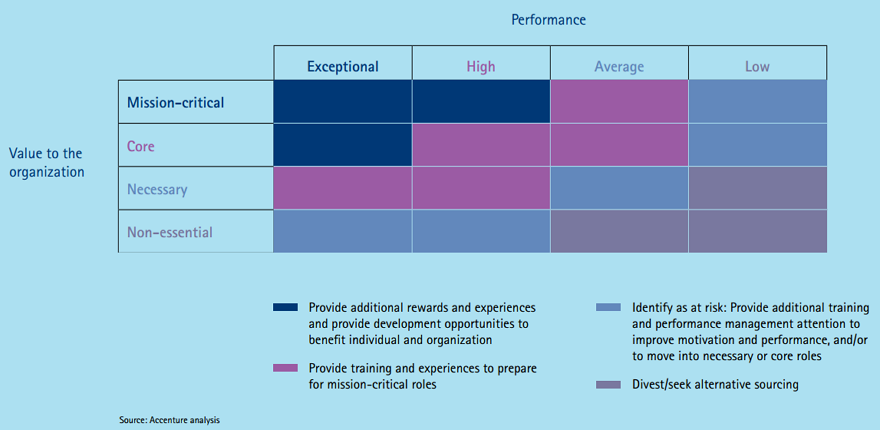
Companies need a more comprehensive approach to reducing workforce costs without impairing workforce quality. To do this effectively, a company needs a better understanding of the different roles within its workforce and needs to conduct what we call strategic role assessment, or SRA.

The purpose of SRA is to identify strategic talent—individuals who are top performers relative to their peers and who perform … [ Read more ]

Identifying Employee Skill Gaps

Identifying the areas where organizations need to improve their capabilities most is an important step in any change effort. Such a skill is helpful particularly in times of cost-cutting–where limited training resources must be used to close the critical competency gaps that prevent companies from meeting business objectives.

However, many training programs don’t yield the desired results. One reason is that they are usually launched … [ Read more ]

RAPID

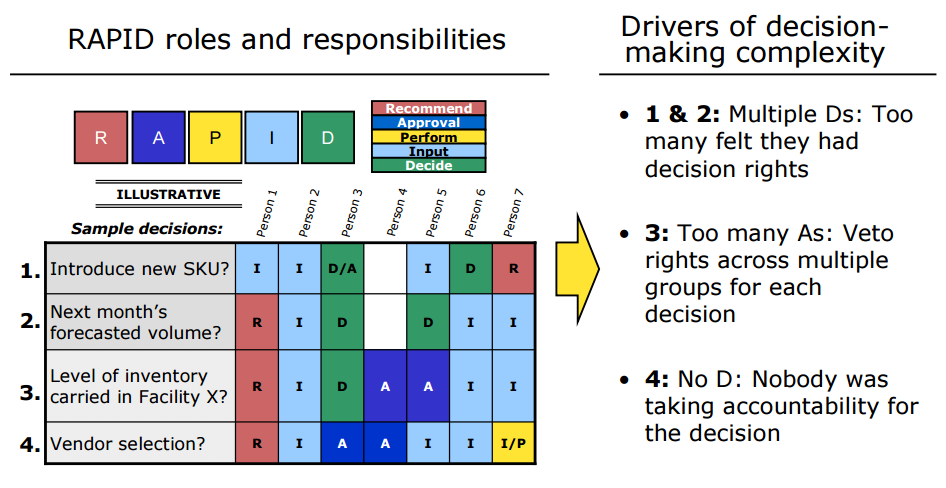
A useful tool to zero in on decision-making problems and create higher-yielding change programs is a decision management tool we call RAPID. The idea is to clearly map out who plays what role in each critical decision and use that to enable swift decisions, without endless debates, second-guessing or pocket vetoes. It determines the captain of the boat, so to speak, but in a more … [ Read more ]

Issue Mapping

Issue mapping involves identifying all the stakeholders and decision influencers involved with ordering, stocking, displaying, promoting, buying, using, servicing and disposing of a product or a service. It helps to paint a fully dimensional picture of its impact and interaction with consumers and the marketplace. It is also quite useful in combination with work-flow mapping, the visual mapping of the steps an individual takes to … [ Read more ]

Downsizing Effectively: Eliminate Hierarchy

The way a company approaches downsizing can make or break its performance. Using 355 undergraduates as their sample, the authors randomly assigned five-person teams to work on military-based command-and-control simulations. The teams’ performance was gauged first at full strength in control groups and then after one of three separate downsizing approaches was applied to the same groups.

The first approach was to maintain the hierarchy, eliminating … [ Read more ]

How to Manage Better in Just 20 Minutes

Ask an employee to write down the names of four people who have had a huge positive impact on his life — peoples he respects, admires, or looks up to. The people can be famous or mundane, real or fictional, dead or alive.

Next, ask your employee about each name, one at a time. Who is this person? Why is he or she important to you? … [ Read more ]

Tracking Employee Skills with a “Passport”

Have employees start their careers by completing a “passport” profile that accompanies them as they move between projects and assignments. As each project is finished, a manager signs off on what the employee accomplished and what skills were updated or acquired. Job responsibilities are defined and competencies clearly indicated for each role, making it much easier to determine specific training and education needs. Succession planning … [ Read more ]

Track What Employees Actually Do

We did a simple thing that in retrospect was brilliant: We wrote a program that asks every engineer what they did every week. It sends them e-mail on Monday, and concatenates the e-mails together in a document that everyone can read. And it then sends that out to everyone and shames those who did not answer by putting them on the top of the list. … [ Read more ]

How to Manage People in 15 Minutes a Day

It’s how you lead, not how much, that counts. Want to have maximum impact in minimum time? Use what I call the 3.1% Coach method. Limit your people-development activities to no more than 15 incremental minutes per day (that’s 75 minutes a week, or 3.1% of a hypothetical 40-hour workweek). Then employ the “smart coach approach” to leverage that tiny slice of time for results.
[ Read more ]

Deploy a Redeployment Pool

Intel monitors changing skill requirements and institutes a redeployment program when it becomes necessary to downsize a business. Under this program, managers effectively lay off people, and the head count of the business unit is moved off the payroll. These excised people enter a redeployment pool under the auspices of human resources. Once in the pool, employees generally have four to six months, and can … [ Read more ]

The Entire Business Should Be the “Customer Service Department”

Obviously, a customer service department is needed, but the traditional customer service mentality needs to be replaced by a tribal mentality.

Employees from all levels of the business should actively be making connections with customers. Not just when a customer is having trouble, but through every phase of business. Here’s a great idea: Each day, allow one randomly selected customer service phone call or email to … [ Read more ]

Use Downsizing as a Last Resort: Some Alternatives

  • Rely on attrition to right size.
  • Use redeployment and make layoffs a last resort. Hewlett Packard used this strategy extensively throughout the 1980s as it faced intensified competition. Employees were given three months to find a job in HP and were helped to do so. If they could not find an equivalent level job, they were offered a lower level job. If they preferred

[ Read more ]

Use action learning projects to address current policy or strategy issues

What’s the secret for building enduring client relationships? How do you make these relationships the cornerstone of your company’s reputation in the eyes of employees and investors as well as clients? And how do you avoid being overtaken and marginalized by shifting competitive forces to consistently offer superior value to clients? My answer…consists of five precepts or pillars: Surround yourself with good people. Invest in … [ Read more ]

Educating IT Professionals in Business Strategy

A very successful technique for educating IT professionals in business strategy is to assign them to mentor senior corporate executives. In what turns out to be mutual mentoring, the business professionals learn what the company’s IT systems can do, how to evaluate and use different PC software, navigate the Internet, and how to better understand IT as they’re teaching the IT professionals how rational decision-making … [ Read more ]

Putting Your Business Activities on Trial

Here’s some very sound advice Peter Drucker has been giving us for at least three decades now, “every three years or so, the enterprise must put every single product, process, technology, market, distributive channel, not to mention every single staff activity on trial for its life. It must ask: Would we now go into this product, this market, this distributive channel, and this technology today? … [ Read more ]

Enhance Managers’ Ability to Commit Deeply to Projects

In 1984, Michael Hilti, then CEO and now Chairman of the Supervisory Board, launched an initiative designed to enhance his managers’ ability to commit deeply to projects. “I want our managers to take responsibility for what they do”, he said. “One of the central conditions for this is that they love what they do. The second is that they are aware that they have choices. … [ Read more ]

Practice the “Law of Three” when assessing applicants

The third time is often the charm-especially when searching for the perfect job candidate. Brian Tracy, author of Hire and Keep the Best People: 21 Practical and Proven Techniques You Can Use Immediately, recommends practicing the “Law of Three” when assessing applicants. To apply this technique, Tracy suggests that you interview at least three candidates for any position, then interview the applicant you like most … [ Read more ]

Support your employees by allowing them to support each other

As Jerome Mattern, chairman of the compensation and benefits committee at the Society for Human Resource Management, explains, “A vacation donation policy is a kind way for employees to engage in social camaraderie.” Such a program allows workers to donate vacation hours to a common “bank,” from which employees who are unable to work due to personal illness or crisis may draw. Employees in need … [ Read more ]

Examine Your Control Systems

Control systems are one of the most important, least understood, and least examined aspects of management that we have today. Most companies tend to accrete their control systems, whether on the financial, production, or sales side. So over time you get hundreds of these systems. If you ask companies how many control systems they have, they don’t know. If you ask them how much they’re … [ Read more ]

Advancing innovation with a “Mutual Fun” market

Jim Lavoie, CEO of the technology firm Rite-Solutions, built something called a “Mutual Fun” market within the company’s intranet that has three indices employees can invest in—Savings Bonds for ideas on saving costs, Bow Jones for ideas on extending existing products, and Spazdaq for new product concepts. Any Rite-Solutions employee can suggest a new idea in any of these markets. Workers can also view the … [ Read more ]